The De Hoop coastline is believed to be one of the most important nursery ground for Southern Right Whales in the world and about 100 cow-calf pairs can be seen close inshore along the coast during the peak whale season.
 |
Historically, this species was regarded as the right kind of whale to hunt because it provided much oil and whale-bone, was easy to harpoon and did not sink when harpooned. Stocks were greatly depleted by whaling in the 19th century. Although the southern right whale has been protected since 1935, numbers are still low but are now recovering in many parts of their range, including off South Africa, where they are increasing at about 7% per year. The species feeds on tiny crustaceans (copepods) in sub-Antarctic waters during the late summer, migrating northwards to areas such as southern Africa in winter in order to mate, calve and rear the young. The whales are often seen about half a kilometre off the shore of the reserve from about May or June to December each year. The peak of the birth season is mid-August. The southern right whale has no dorsal fin and the double or V-shaped blow is characteristic. Individuals may be recognised by the pattern of outgrowths or callosities of roughened skin on their heads. The adults are sometimes closely followed by calves. The whales are slow-moving, usually non-aggressive and placid.
These whales only calve every three years, so the population is separated into three groups of calving adults. Last year was the lowest grouping of mating whales and this year is believed to be the so-called bumper year, with 2012 being the year in-between.
There is in general a westwards movement every year, towards the end of the season, as cows move along the shore and eventually head off south or up the west coast to feed. In addition to this movement the entire distribution of the population seems to be shifting westwards over time, so we now see almost as many whales from Agulhas to Muizenberg as there are from Nature’s Valley to Agulhas.
So while in the past there were relatively low numbers of animals along the De Hoop coastline, in recent years the area has hundreds of animals. According to previous aerial counts 2008 was a good year with counts of over 400 whales in De Hoop Bay, 2009 approximately 250 and about 200 in 2010. Therefore 2011 is set to be a bumper year at De Hoop for large numbers of Whales.
Interesting facts on the Southern Right Whale
- Total population: 5 000
- SA population: 1 200, about 25% of which may occur along the coast in any one year (including 13% of the world’s calves)
- 35% between Arniston and Infanta (including 50% of total SA calves)
- Adults 14 to 18 m long, mass 55 metric tons
- Calves 5 to 6 m at birth
- Normal swimming speed: 3 knots
- (5,5 km/h)
- Breeding season: midwinter
Accommodation at De Hoop
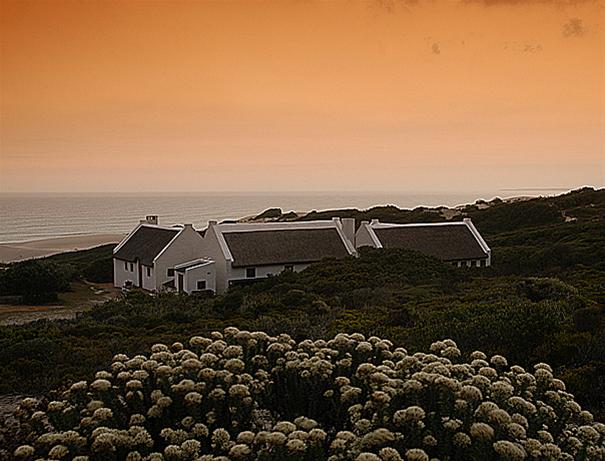 |
Koppie Alleen - De Hoop Collection
For those wishing to stay at De Hoop during the whale season, there are plenty of varied accommodation options on offer. These vary from the affordable campsite rondavels, an assortment of self-catering cottages and larger houses or the Opstal Manor House, which includes all meals catered for at The Fig Tree restaurant. For those wanting a more private option, there is the charming Koppie Alleen set on its own – overlooking the bay.
The De Hoop Reserve
The Reserve is renowned for its rich offering of things to do and see, and guests can intersperse their wine tasting activities with mountain biking, scenic hikes, birding, snorkelling, and more. Day visitors are welcome, and guests may leave their vehicles at any time to tour the area.
Described as ‘the jewel of the Western Cape’, the De Hoop Nature Reserve is the perfect setting for a three day celebration of some of the country’s most delicate and decadent wines on offer. For those with a taste for luxury and the gorgeous Cape landscape, this is an event not to be missed!
Call the De Hoop Collection on 0861 33 4667 or email res@portfoliocollection.com