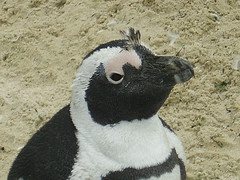
About the African Penguin
The African Penguin is also known as the Black-footed Penguin. It is known as Brilpikkewyn in Afrikaans, Inguza or Unombombiya in Xhosa, and is most commonly known as the Jackass Penguin because of its donkey-like call.
Here in South Africa one can easily encounter the African penguin, largely in the Western Cape.
Boulders Beach, near Simons Town, is home to a colony of 3 000 African penguins. It is one of only three mainland spots in South Africa where the penguins have established colonies. Boulders is the only one where penguins and beachgoers happily share the beach.
Other places where the African Penguin can be found in South Africa are Betty''s Bay in the Overberg, and Cape St Francis in the Eastern Cape.
 |
Penguin Under Threat
Did you know that the African Penguin is one of South Africa''s threatened bird species?
If you''ve visited Boulders you may be surprised to hear this as the little waddling critters are everywhere, braying, breeding, standing about looking at each other, and playing in the sea.
According to Wikipedia:
Of the 1.5-million African Penguin population estimated in 1910, only some 10% remained at the end of the 20th-century. African penguin populations, which breed in Namibia and South Africa, have declined by 95 percent since preindustrial times.
Among their biggest threats are commercial fisheries (which have forced them to search for prey farther off shore, as well as making them eat less nutritious prey, since their preferred prey has become scarce) and global climate change which also affecting these penguins'' prey abundance.
As recently as the mid-twentieth century, penguin eggs were considered a delicacy and were still being collected for sale. Unfortunately, the practice was to smash eggs found a few days prior to gathering, to ensure that only fresh ones were sold. This added to the drastic decline of the penguin population around the Cape coast, a decline which was hastened by the removal of guano from islands for use as fertilizer, eliminating the burrowing material used by penguins.
Penguins remain susceptible to pollution of their habitat by petrochemicals from spills, shipwrecks and cleaning of tankers while at sea.
 |
Adopt a Penguin
Sadly, many penguins suffer the effects of oil spills and require rescue and rehabilitation following one of these all too common events off our coastline.
SANCCOB, a sea-bird rehab centre, responsible for the health and well-being of the penguins in South Africa. They rescue, rehabilitate and release ill, injured, oiled and orphaned sea birds.
The care of the penguins is an ongoing job for SANCCOB and they rely heavily on donations.
They have set up a fantastic initiative with their Adopt-A-Penguin scheme - this is a source of much-needed funding for their work, and a unique gift idea for a loved one who is ecologically minded.