“So you want to see the secret cave?” asked my host, Robert Haarburger, nonchalantly motioning to a small, dark crack in the ground.
I laughed out loud, thinking he was making a joke, “Yeah, sure I do” but his look told me he was serious, and then the penny dropped.
I stammered, “You mean you want me to crawl through… that… hole?” It looked tiny and I couldn’t imagine it would lead to anything but a terrifying, bat-infested, spider-riddled death.
“You first” he smiled brightly, “you’re a lot younger than me.”
 |
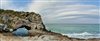
We were standing on a vertical cliff, one of the most distinguishing features of Arniston’s rugged limestone coastline which has, over the millennia, been sculpted to the whim of the wind and the sea like proverbial Playdough. Today it forms a series of dramatic arches, outcrops, contours, clefts, ridges, overhangs and caves.
The most famous of these is Waenhuiskrans, meaning ‘wagon house cliff’, so named because Dutch settlers believed it was big enough for an ox-wagon to turn around in. Submerged at high tide and pounded by incredible surf in between, low tide reveals a small entrance, giving the intrepid the chance to steal a few moments in this uninhabitable space.
This is a place where the dark, dripping rocks inside contrast against the brightly lit and splashing turquoise outside – an experience that makes your heart beat with almost the same force as the crashing of the waves.
 |
But now I was about to see another one of Arniston’s secrets, a lesser known cave which might have served as shelter to the ancient Strandlopers, or at the very least to a few jovial characters over a modern campfire in our more carefree age. Robert looked amused as I wedged myself into the hole, legs dangling, arms gripping, my feet searching for a landing. Small rocks dislodged and disappeared into the darkness beneath me. Finally I touched down and Robert scrambled in behind me. The cave was room-sized and offered a view over Arniston framed by its own ragged-edged eye. The rumbling of the waves as the sea heaved itself against the rocks below us sounded deep and powerful while the sight of birds gliding by just out of reach in the window of the cave’s opening formed a tranquil scene, all to the soundtrack of the whistling wind.
 |
Robert Haarburger is an Arniston local – he grew up here, travelled and lived overseas, and eventually returned two decades ago, transforming property that his family owned into some of the only sources of local employment in the village – the relaxed Arniston Seaside Cottages, and the iconic Arniston Spa Hotel. He says with the shrug of a man resigned to the temptation of his heart, “People told me I was crazy to return, but I love Arniston. No matter where I travel in the world, it always calls me back, like it has a piece of my heart.”
We clambered out of the cave and into Robert’s waiting dune buggy, which looked equipped to take us just about anywhere.
From the Struispunt Beacon, past ancient middens (heaps of ancient shells, bone and other artefacts discarded by Strandlopers from the Middle Stone Age…) to the farthest reaches of the bay along a bumpy, muddy, sandy all-terrain road that eventually peeled away to reveal the windswept horizon, crashing surf, rocky coast and more of that turquoise water – Arniston offered up her little-known treasures from every vantage point.
 |
Two-hours from Cape Town, Arniston is accessible along a finger of road that extends 25-kilometers past the closest town, Bredasdorp, towards the southern reaches of South Africa’s coast. Relatively isolated and undeveloped, Arniston is known as a coastal retreat. Set against an aquamarine sea, the village is dotted with thatch-roofed white-washed cottages, the most famous ones forming the 200-year old Kassiesbaai, home to generations of villagers – in fact, the only people allowed to live there are the few that have been born there.
Two of these villagers, Merci and Christopher, took some time to show me around and together we wandered the paths between the historic buildings while curious children trailed behind us like we were part of the Pied Piper’s secret envoy. They pointed out the local Craft Market and Willene’s, a restaurant where tourists can enjoy a local’s meal, along with the cottages of their family, neighbours and a few which stood empty after the passing of another generation. It was clear that they were part of a close-knit community that was more like their family.
 |
Recognized as a National Monument, the sandstone fishermen’s cottages of Kassiesbai are bordered on one side by the town of Arniston and on the other side by a sea of sand dunes overlooking the site of the wreck of the HMS Arniston Transport.
One the worst nautical disasters of all time, 372 lives were lost and only six survived when this East Indiaman ship – which had until then survived pirate attacks and eight journeys between Great Britain and the Far East – sank unceremoniously in 1815. Apparently the owners of the ship didn’t put much stock into accurate navigation and decided it would be better to save a couple of bucks than to buy a marine chronometer, yesteryear’s GPS. Travelling in a convoy of six other ships, the Arniston had to rely on them for accurate navigation. As with most things in life, you don’t really need them until you really, really do. Unfortunately for the Arniston the weather did not play along and a week before her demise the she was given a death sentence.
Bad weather struck.
Rough seas and gale force winds damaged her sails, separating her from the convoy. The storms continued. Strong ocean currents led to one navigational error after the next, and eventually the Captain fatally headed north, running all 1468 tons aground over the L’Agulhas Reef just 900-metres from shore.
After a week of death row, it was all over for most within a few hours.
Today the ribs of the ship can be seen among the sand dunes, and fragments of its once proud brass-plated hull shine out in shades of weathered green to those who are lucky enough to find them.
.jpg) |
We headed in that direction as the misty, ocean air began to stick to us, cold and clammy. The sun began her descent, lighting up the clouds in shafts like it might have through the patchy sail of the Arniston on her last ill-fated eve.
The dunes rolled out before us like a Magic Carpet, undulating in the wind, while the waning light made it difficult to see where it rose and fell. Unphased, Robert kept up our speed as I held my breath, gripping both the roll-bar and my seat belt, a nervous smile permanently fixed on my face. “Wha-hoooooooo!” I screamed convincingly, trying to quell any thought that I might be in some sort of serious danger, out here in the sand dunes at dusk, as we seemed to freefall down 45-degree angles while Robert explained, nonchalantly of course, that this was much safer than driving along the ridge of the dune. “Oh, yes!” I exclaimed, pink-cheeked and breathless, feeling more like a Yankee than ever.
We made it to the calmness of the beach where the waves had receded with the tide, leaving fields of seaweed strewn in big clumps like discarded piles of confetti. Non-plussed as usual, Robert simply drove over them.
Before long we had arrived. The history of the Arniston was alive in this place by the sea – her weathered bits lay at rest between a view over the dunes on one side and a seaview over the town that shares the same name on the other. Yet what could have been a sombre end to a thrilling day filled with historical intrigue and the beauty of nature’s creation suddenly turned lucky.
“Hey, over here”, called Robert, pointing to something in the white sand. I could see the luminous green from where I stood, glowing in the setting sun. It was a piece of the Arniston’s brass plating, the tiniest of little shards. “It’s a piece of the Arniston, ” Robert offered, “Take it with you – keep it in your heart.”
Images and story by Theresa Lozier
First published on March 5, 2012 at www.fineplaces.co.za
About the blogger

Theresa Lozier is a writer and photographer specializing in articles about travel, adventure, fine dining and wine. With a decade of experience working in some of the world''s most awarded advertising agencies, Theresa left her home in Santa Monica, California to pursue her dream of a life and love in Africa. She lives with her partner in Noordhoek, Cape Town just steps from the sand and the sea.
Theresa started www.FinePlaces.co.za in 2011 and at this time she is also a contributor to the Getaway Magazine Blog. Her articles and photo essays cover a diverse range of topics from the adventure of a safari in Botswana''s Okavango Delta, the decadence of traveling by rail through a byegone era, and savouring some of South Africa''s finest culinary delights to the thrill of kayaking around Cape Point and zip-lining through the ancient heights of the Tsitsikamma forest.
Accommodation at Cape Agulhas
 |
 |
Portfolio offers handpicked accommodation at Cape Agulhas.
Visit www.portfoliocollection.com or contact res@portfoliocollection.com for bookings.