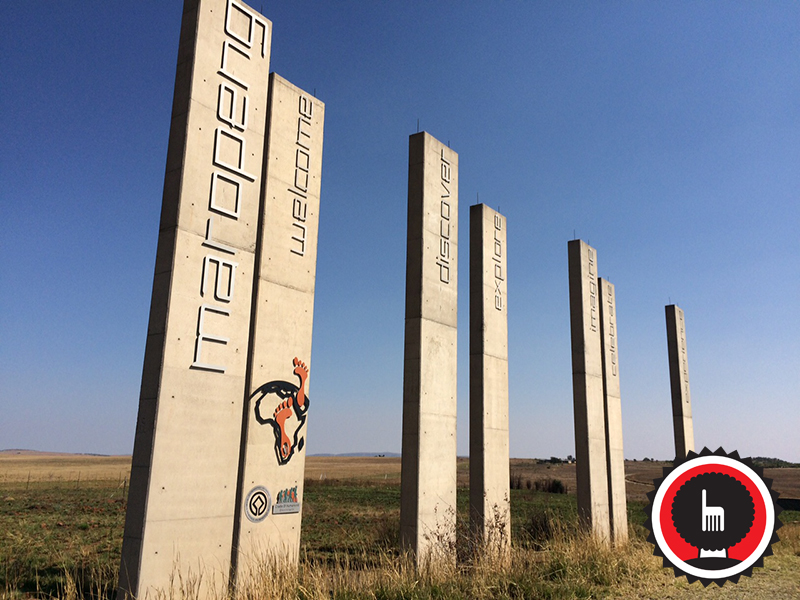
I was there this afternoon, and found myself captivated. Let me be clear, I have rather limited cranial capacity on these topics and it all seemed rather academic when this discovery made the news last week. But seeing an almost complete, 2 million year old skeleton of one of our relatives, is really quite something.

At the site were researchers from Wits University - including one of the young academics who found the stash of bones after crawling some 90 meters through a network of underground caves, and down a rock chute only 20cm wide in places!
The Cradle of Humankind contains hundreds of dolomitic caves, into which animals and hominids and everything else have fallen over millennia. The caves provide a degree of shelter from the elements, and so bones remain preserved, to an extent - although by the time scientists get to them, bones are usually scattered and broken and they have to do an awful lot of guesswork to piece together the skeletons.

What was discovered recently was a previously unknown hominin relative called Homo naledi, which looked rather like a small human - with very familiar looking hands and feet - but with a brain the size of an orange.
What was so extraordinary for me about the Naledi find is that these skeletons are almost perfectly preserved, and also appear to be only of one species, which means that they weren''t dragged here by predators (or their bones would be broken) and they didn''t fall in by accident (otherwise other species would have fallen alongside them). It would mean that they were deliberately placed here - which means that 2 million years ago, with brains the size of oranges, they had the ability to follow a ritual to dispose of bodies after death.

It was quite a privilege to be able to talk with the very people who made this incredible discovery and after my short time in the room with the fossils I left with so many questions, and some great fodder for future discussions around the dinner table!